Biochemical methane potential tests, often called BMP tests, are used to measure how much methane a substrate can produce during anaerobic digestion. They are widely used for feedstock evaluation, pretreatment studies, codigestion trials and additive testing.
A well planned BMP test can provide valuable data for biogas production. A poorly designed test can give inaccurate, confusing or difficult to reproduce results.
Fortunately, many BMP test errors are avoidable. The most common problems are linked to experimental design, inoculum selection, sample preparation, mixing and data analysis. Getting these steps right is important for reliable methane potential results.
Experimental Design
The first big mistakes that can be made with a BMP test is poor experimental design. To validate a BMP test, triplicate samples including the substrate or feedstock, a blank (just inoculum) and a positive control with known biodegradation behavior, such as cellulose, should be used. Utilising an inoculum blank and positive allows you to verify the inoculum activity.
Furthermore, when testing the effects of additives too, an additional “blank” group, containing just the additive and inoculum, should be used to ensure increased gas producing is a result of the additives effect. Often, researchers believe their additive to be significantly increasing gas production when instead it is itself biodegrading and producing gas, as additional substrate.
Designing the experiment well means errors can be minimised, statistical tests can be utilised and most importantly, problems with the test can be identified and resolved. For example, if one replicate has a significantly lower gas production than others that may indicate a couple of things. Good experimental design allows us to differentiate if it is caused by human or system error, such as a leaking reactor, or another reason, such as a substrate that won’t degrade or poor inoculum quality. These outliers can later be eliminated for data analysis.
Selecting Inoculum
The inoculum has a major effect on BMP test results. A weak, unsuitable or poorly handled inoculum can lead to low gas production, long lag phases and unreliable results.
Before starting a BMP test, it is important to consider the purpose of the experiment. Is the test mesophilic or thermophilic? Does the inoculum need pretreatment? Is it representative of the anaerobic digestion process you want to study?
The inoculum should be active, well adapted and handled in a way that preserves microbial activity. Storage time, temperature changes and exposure to oxygen can all affect performance. Using a suitable inoculum blank and positive control helps confirm that the inoculum is working properly during the test.
Sample Preparation and Handling
During sample preparation for BMP tests, the volatile solids % (VS) of the substrate is often used when calculating how much to add to each reactor. However, literature reported values of VS can be confusing. For example, some VS are reported as percentage of the “wet” sample (VSwet) and some percentage of the total solids or “dry” sample (VSTS). It Is important to use VSwet for calculations of substrate to add (calculations of the inoculum substrate ratio, ISR). At BPC Instruments, we recommended always calculating your own VS and TS before conducting experiments.
Not all samples are created equal, and while some substrates are easy to work with others may prove more difficult. An optimal substrate does not contain large particles, so some preparation and grinding of the substrate may be required. Unfortunately, some feedstock, such as straw, comprise large particles and can be hard to process. It is therefore critical to mix the mixture well before starting the experiment and ensure sufficient mixing throughout. Insufficient mixing may lead to bubbles of produced gas forming, which release sporadically and affect the kinetics seen in final results.
Data Analysis
Even a well designed BMP test can produce misleading results if the data analysis is handled incorrectly.
Calculation errors are common in BMP testing. Data can also be difficult to compare if the correct corrections are not applied. Methane production from the inoculum blank should be subtracted from the substrate sample. Results should also be normalised to standard conditions, typically 0 °C, 1 atm and dry gas conditions, so that data can be compared between experiments and laboratories.
Temperature, atmospheric pressure and water vapour can all affect gas volume measurements. Without normalisation, two tests using the same substrate and methodology may still appear different because of local laboratory conditions.
Another common error is failing to account for reactor headspace flushing. This is important when the gas composition in the headspace differs between the beginning and end of the BMP test. The effect may seem small, but ignoring it can lead to large errors or unpredictable data.
Reliable BMP test results depend on both good laboratory practice and careful data handling.
Conclusions
While BMP test methodology is relatively standardised, it is still important to take care with the following factors to avoid inaccurate data:
- Experimental design
- Inoculum selection
- Sample preparation and handling
- Data analysis
AMPTS® III is designed for reliable BMP testing by automating gas volume measurement and data acquisition throughout the experiment. With 18 parallel reactors, online monitoring and built in normalisation and correction functions, the system helps reduce manual readings, calculation errors and variation caused by local temperature and pressure conditions.
This makes it easier to compare results between samples, experiments and laboratories. AMPTS® III also supports BMP, SMA and residual gas potential testing, and is the only automated test apparatus referenced in VDI 4630 for these methods.
Biogas & Biomethane
Learn more about our work in biogas and biomethane
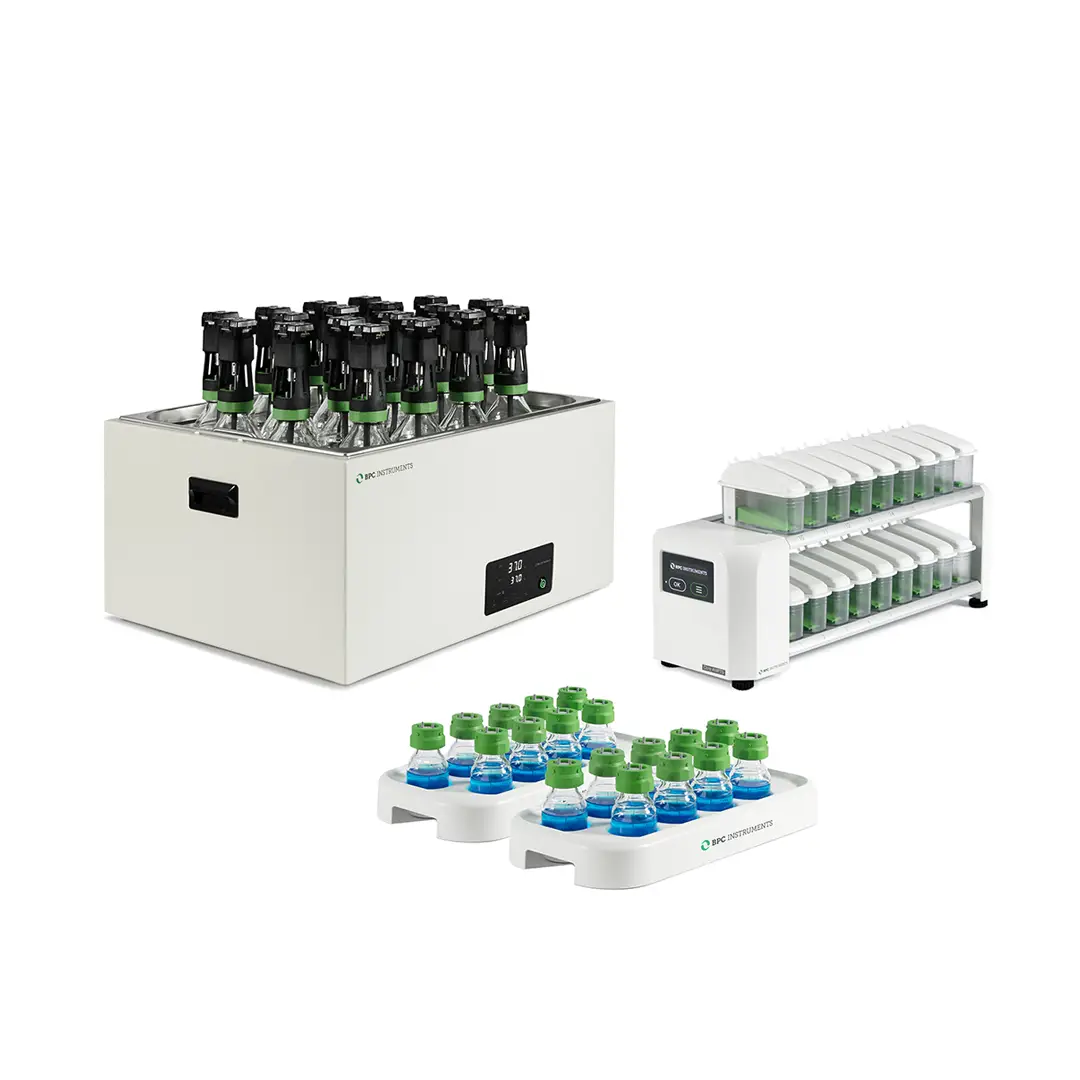
AMPTS® III
Analytical tool for biogas and biomethane analysis