Biohydrogen
Automated gas measurement for biohydrogen potential and dark fermentation studies. Our instruments help laboratories evaluate feedstocks, hydrogen producing microorganisms, pretreatment methods and operating conditions in controlled anaerobic batch tests.
- Biohydrogen potential testing
- Dark fermentation workflows
- Automated gas measurement
Trusted by laboratories, research institutes and industrial customers worldwide.











Turning fermentation into measurable data
Biohydrogen is hydrogen produced by microorganisms from organic material. In laboratory testing, the goal is often to understand how much gas a feedstock can produce, how quickly production starts and how process conditions affect hydrogen rich gas formation.
BPC’s instruments automate gas volume and flow measurement in anaerobic batch fermentation studies. This helps laboratories compare substrates, test pretreatment methods, evaluate hydrogen producing cultures and follow gas production over time with less manual handling.
What can you study with BPC instruments?

Biohydrogen potential
Measure gas production from organic substrates under controlled dark fermentation conditions to calculate the biohydrogen potential (BHP) of a substrate.

Feedstock and pretreatment comparison
Compare substrates, mixtures or pretreatment methods to see how they affect hydrogen rich gas production.

Hydrogen producing microorganisms
Evaluate inocula, cultures or microbial communities based on their gas producing behaviour.

Process conditions
Study how pH, temperature, substrate concentration or inoculum selection affect gas production kinetics.
Dark fermentation testing
Dark fermentation is a biological process where microorganisms break down organic material and produce hydrogen rich gas under oxygen free conditions. In research and process development, batch tests are often used to compare feedstocks, screen inocula and evaluate operating conditions.
Our instruments measure gas volume and flow during the test period. When hydrogen concentration or gas composition is required, the gas data can be combined with complementary gas analysis according to the selected protocol.

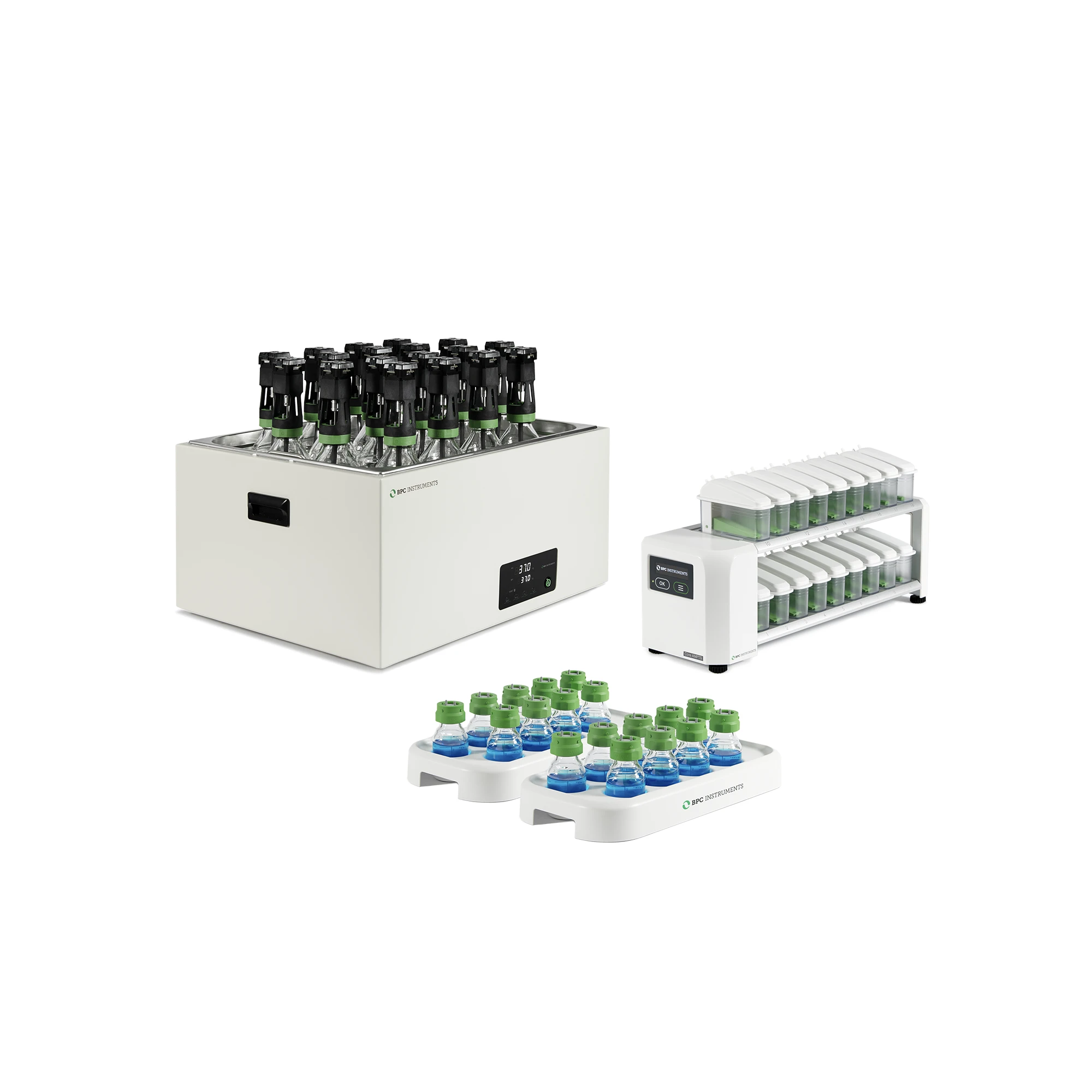
Gas Endeavour® III
Gas Endeavour® III is BPC’s preferred instrument for biohydrogen potential and dark fermentation studies. It is designed for automated low gas volume and flow measurement in batch fermentation tests.
The system helps laboratories follow gas production kinetics, compare samples and significantly reduce manual readings during long running experiments. It can be used to study feedstock potential, microbial activity, pretreatment effects and operating conditions in biohydrogen research.
Why laboratories use BPC instruments

Automated gas measurement
Reduce manual readings, save time and follow gas production throughout the experiment remotely.

Parallel batch testing
Run samples, controls and replicates in parallel for more structured comparison.

Kinetic data over time
Follow the rate and level of gas production during the full test period.

Flexible instrument routes
Choose Standard or Light versions of Gas Endeavour® III or AMPTS® III 18 or 9 channels depending on your sample throughput and test setup.
Common questions about biohydrogen testing
What is biohydrogen potential testing?
Biohydrogen potential testing evaluates how much gas can be produced from a substrate under controlled anaerobic conditions. It is commonly used to compare feedstocks, inocula, pretreatment methods and operating parameters in dark fermentation research.
What is dark fermentation?
Dark fermentation is a biological process where microorganisms convert organic material into hydrogen rich gas without light and without oxygen. It is one of the main laboratory routes used in biohydrogen research.
Which BPC instrument is used for biohydrogen studies?
Gas Endeavour® III is the preferred BPC instrument for biohydrogen potential and dark fermentation studies. AMPTS® III or its light version can also be relevant for anaerobic batch fermentation workflows depending on the setup.
Can BPC instruments measure hydrogen concentration?
BPC’s instruments measure gas volume and gas flow. When hydrogen concentration or gas composition is required, the gas data can be combined with complementary gas composition analysis according to the selected protocol.
Can BPC instruments be used to compare feedstocks?
Yes. Our instruments can be used to compare gas production from different organic substrates, feedstock mixtures or pretreatment methods under controlled laboratory conditions.
Can the systems be used for microbial screening?
Yes. Biohydrogen studies often involve screening inocula, cultures or microbial communities to evaluate their hydrogen producing capability. Automated gas measurement helps follow their gas production behaviour over time.
Related scientific references
-

Continuous Hydrogen Production from Syngas via the Biological Water-Gas Shift Reaction in a Trickle Bed Reactor: Effect of Nutrient Management, Inhibitors, and Hydraulic Retention Time
Alvaro dos Santos Neto, Konstantinos Chandolias, Mohammad J. Taherzadeh et al., 14 October 2026, PREPRINT (Version 1) available at Research Square
-
Differential contributions of iron-based nanoparticles to dark fermentative biohydrogen production: Towards a rational selection of application
Geng Luo, Mei-Yi Bao, Jie Ding, Zi-Tong Zhao, Ji-Wei Pang, Lu-Yan Zhang, Nan-Qi Ren, Shan-Shan Yang, Bioresource Technology, Volume 449 (2026) 134351
-
Transforming Vegetable Waste Potential Into Biohydrogen and Biomass Using E. Coli
Jorkntsyan, Liza, Vanyan, Liana, Toleugazykyzy, Akerke, Bekbayev, Kairat, Trchounian, Karen, Transforming Vegetable Waste Potential Into Biohydrogen and Biomass Using E. Coli, International Journal of Energy Research, 2026, 7149980, 12
Anaerobic Digestion, BiohydrogenJournal article2026 -
Efficient co-valorization of sugar beet pulp/molasses hydrolysates by Escherichia coli for enhanced biohydrogen production
Ani Aghajanyan, Gayane Mikoyan, Liana Vanyan, Akerke Toleugazykyzy, Ayaulym Daniyarova, Kaisar Yegizbay, Kairat Bekbayev, Karen Trchounian;International Journal of Hydrogen Energy, Volume 242, 2026, 155559

Contact our experts
Tell us what substrates you work with, which test setup you are planning and whether you need Gas Endeavour® III, AMPTS® III or a smaller Light configuration. Our application experts can help you find a suitable instrument setup.
For urgent matters, please call us on +46 (0) 46 16 39 50.
"*" indicates required fields